If birds are nesting in or near your gutters, the nest must be left alone while it’s being built or used. The Wildlife and Countryside Act 1981 protects the active nests of wild birds. Once the young have left and the nest is no longer in use, the gutter can be cleared and the old nest removed.
What does the law say about nests?
In England, the Wildlife and Countryside Act 1981 makes it an offence to intentionally take, damage or destroy the nest of any wild bird while it is in use or being built. This covers common birds like sparrows, starlings, house martins, pigeons and gulls. Once the nest is no longer in use, it can be removed.
Which birds nest in or near gutters?
- House sparrows and starlings: often under tiles or in gaps at the eaves
- House martins: mud nests under the eaves
- Pigeons: on ledges, gutters and flat roofs
- Herring gulls: on roofs and chimneys, common in coastal Essex towns
When is the nesting season?
Broadly from late winter to late summer, roughly March to August, though some birds nest earlier or later. Gulls are typically nesting from spring into summer.
What should I do if a nest is blocking my gutter?
Wait until the nest is no longer in use. Then the gutter can be cleared and the old nest removed. If water is overflowing in the meantime, it’s usually a short wait. We won’t disturb an active nest.
How can I tell if a nest is in use?
Birds coming and going, calls from chicks, or adults guarding the area are all signs. The camera can sometimes show it, but we keep our distance if birds are active.
Can I stop birds nesting in gutters again?
Outside the nesting season, options include bird spikes or wire on ledges, and gutter guards in some cases. Fitting these is a job for a pest control or roofing company. Keeping gutters clear also makes them less attractive.
Are gulls a problem in Essex?
In coastal towns like Southend, Leigh, Canvey, Clacton and Maldon, herring gulls often nest on roofs. Their nests and debris can block gutters and outlets. Gulls are protected like other wild birds.
What about wasps or bees?
Wasp nests near gutters need a pest controller. Honey bees are best moved by a beekeeper. We won’t work near an active nest.
What happens when the nest is gone?
We clear the gutter and the old nest, check with the camera and test the downpipe. Gutter cleaning.
Can a nest in a gutter cause damage?
It can block the gutter or the outlet, so water overflows onto the wall below. Gull nests in particular are bulky, and on flat or low roofs they can sit right over an outlet. The damage is the same as any blocked gutter: wet brickwork, green streaks and damp patches. Because the nest has to stay until it’s no longer in use, it’s worth keeping an eye on where the overflow lands and protecting anything underneath.
What if water is pouring into my house because of a nest?
If a nest is causing water to come inside, get advice before touching it. Natural England publishes guidance on wild birds and the law, and in some cases licences can be issued for specific problems. Don’t remove an active nest yourself. In most cases, the safest answer is to manage the water temporarily, for example by moving things away from the overflow, and wait for the young to leave.
How do I know when a nest is no longer in use?
When there’s been no activity for a while: no adults coming and going, no chick calls, and the young have clearly fledged. Small birds like sparrows and starlings can raise more than one brood in a season, so a quiet week doesn’t always mean they’ve finished. If in doubt, wait a little longer. Late summer and autumn are usually safe.
Do you remove old nests?
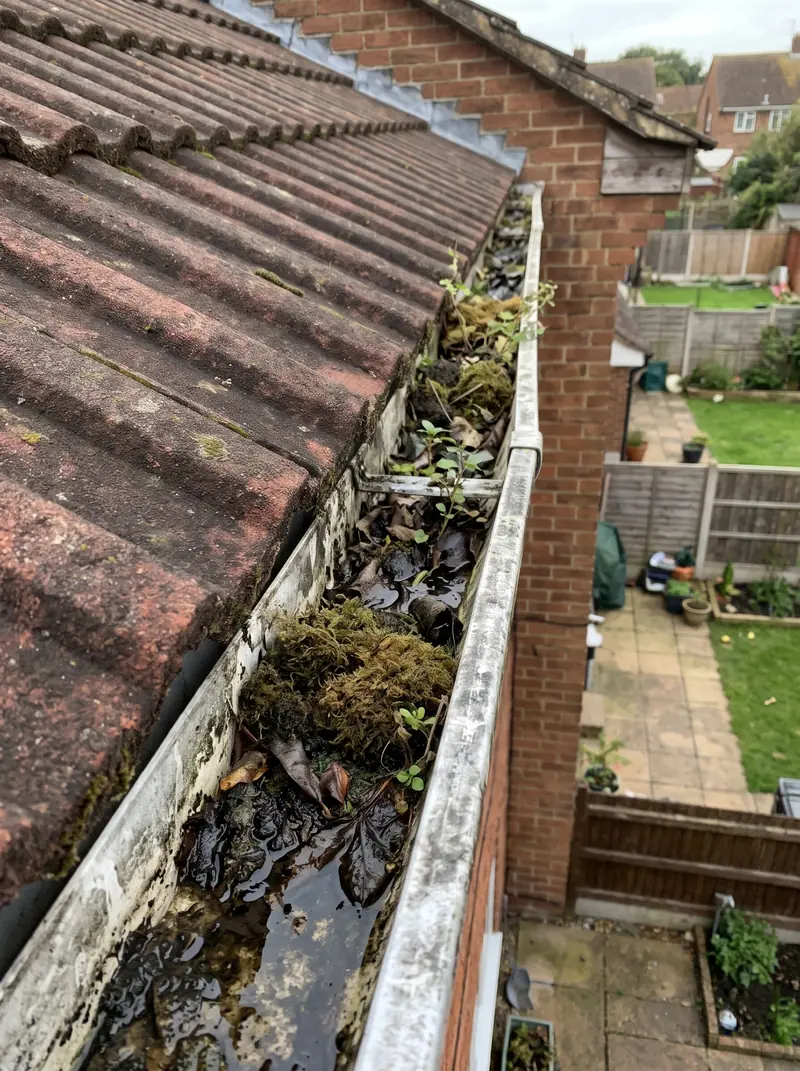
Yes, once they’re no longer in use. Old nests are usually a mix of twigs, grass, moss and droppings. We vacuum them out with the rest of the gutter debris, check the outlet with the camera and run water down the downpipe to make sure it drains.
Are swifts and house martins treated differently?
They’re protected in the same way as other wild birds, and both are species of conservation concern, so their nests deserve extra care. House martins build mud cups under the eaves, often above gutters, and return to the same places year after year. We work around them and never knock down martin nests.
How can I make my roof less attractive to nesting birds?
Outside the nesting season, keep gutters clear so there’s no ready-made nest material, block gaps under the bottom row of tiles and at the eaves, and ask a pest control or roofing company about deterrents for flat roofs and ledges. Never block a gap while birds are using it.
Do you check for nests before cleaning?
Yes. The camera look at the start of every job shows what’s in the gutter, and we watch for birds coming and going around the roof edge. If there’s an active nest, we leave that section alone, clear the rest of the gutters, and come back once the nest is no longer in use.